Reigns
- 4.3
- Rating
- 1.00M
- Installs
- $2.99
- Price

 Analysis by App-foxy
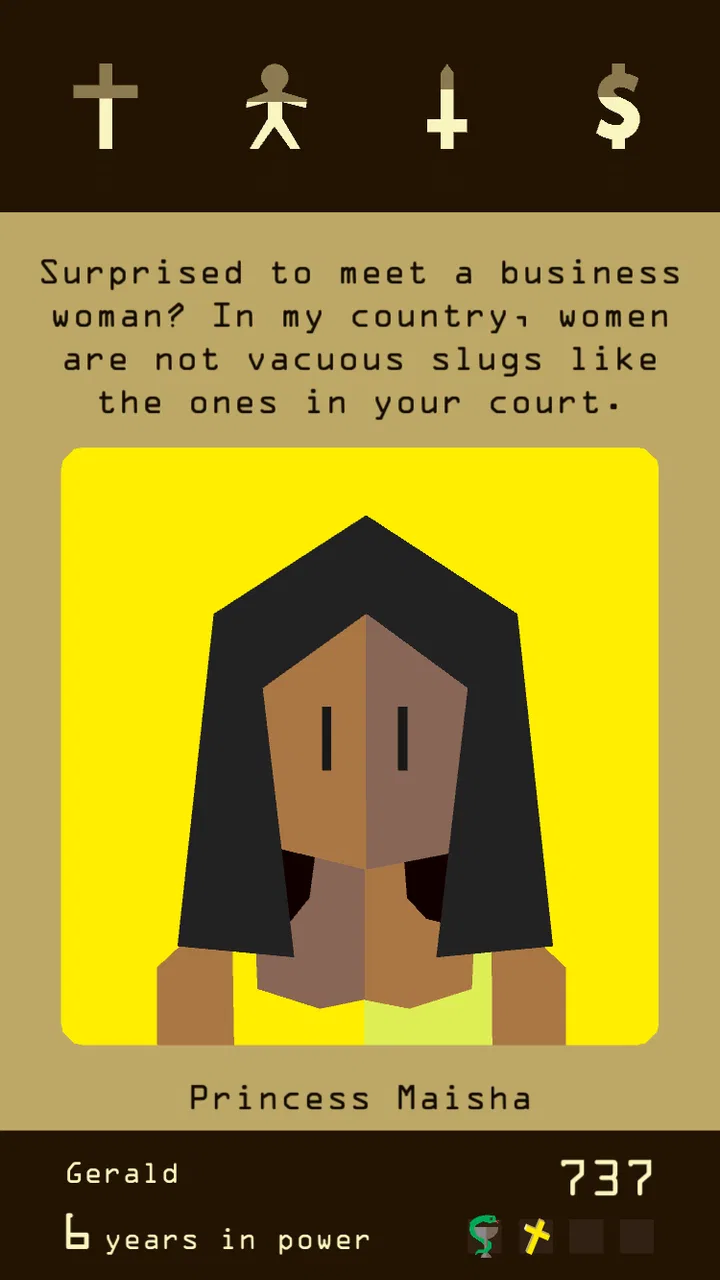
I expected Reigns to be a quick card game that would entertain me for a few spare minutes and then disappear from my phone. Instead, its simple left-or-right decisions created a surprisingly sticky routine. Each card presents a situation, and my choice changes the balance of power around the throne. The rules are easy to understand, but the consequences often arrive later, when I have already forgotten which decision caused the trouble.
That delayed cause and effect is the main reason the game works. I am not building a deck, collecting cards, or learning a complicated battle system. I am trying to survive as a ruler while keeping several competing forces from becoming too strong or too weak. The format feels almost like reading a dark, interactive story one sentence at a time. It is quick to start, easy to pause, and much more thoughtful than the swipe controls suggest.
Why the first week feels so compelling
My first sessions were driven by curiosity. I wanted to see what would happen if I accepted a request instead of rejecting it, or if I tried to please one group while ignoring another. The game gives each decision a clear physical gesture, so the action becomes automatic quickly. Swipe one way, read the result, and move to the next dilemma. That rhythm makes it ideal for a short break, especially when I want something more engaging than an idle game but do not have time for a long match.
You May Also Like

 Blood Strike: 2.5 Anniversary
Blood Strike’s Loadouts Turn Every Drop Into a Tactical Gamble
A close look at Blood Strike’s custom loadouts: how fast access to signature weapons reshapes its battle royale rhythm, rewards preparation, and narrows the gap between fights.

 Pandora - Music & Podcasts
Pandora’s Music Is Easy to Start, but Harder to Recover
Pandora’s strength is its low-effort path from a seed to a station. Its weak spot is how much confidence it asks you to place in connection, setup, and quiet recovery.

 8 Ball Pool
 Is Built on Rivalries, Rematches, and Routine
A close look at the rivalries, rematches, shared routines, and unanswered safety questions that turn a quick pool match into a persistent mobile community.

 Samsung Music
’s Quiet Strength Is Playing What You Already Own
Its reach comes less from spectacle than from dependable access to a personal library. That simplicity is both the app’s strongest retention engine and its ceiling.

 AccuWeather: Weather Radar
AccuWeather Review: A Quick, Clear Forecast for Everyday Decisions
For everyday plans, the best forecast is the one you can understand quickly. AccuWeather makes rain timing, radar, and local conditions easy to act on, with a few trade-offs.

 Hill Climb Racing
Why Hill Climb Racing Still Turns Crashes Into One More Run
A tiny car, a bumpy hill and one more upgrade: Hill Climb Racing keeps resurfacing because its simple chaos makes every near-miss feel personal.
More From Our News Desk
View All News


The card format also makes failure feel informative rather than purely frustrating. When a reign ends, I usually understand that I had allowed one concern to dominate or had made a choice without considering its wider effect. I may not know the exact consequences in advance, but I can often identify the mistake afterward. That encouraged me to begin another run immediately, not because I was chasing a score, but because I wanted to test a different approach.
The writing gives those decisions their personality. Requests from the court, religious figures, soldiers, and ordinary people do not feel like interchangeable prompts. The tone can be funny, grim, absurd, or unexpectedly cruel. I found myself making choices based on the imagined character of my ruler, even when a colder decision might have been safer. That role-playing element is important: the game is not only asking what is strategically best, but also what kind of monarch I want to be.
There is a useful tension between instinct and caution. A fast swipe keeps the game moving, yet rushing makes it easier to overlook which part of the kingdom is becoming unstable. I learned to pause briefly before important decisions and remember the recent balance of power. That small habit improved my results more than trying to memorize every individual card.
The early appeal comes from discovery. New situations appear, unexpected consequences unfold, and the game keeps suggesting that there is another path I have not tried. I would not call the opening completely relaxed, because some outcomes can feel harsh when I am still learning the logic behind them. Even so, the compact structure makes experimentation painless. A failed ruler does not require a long restart or a complicated setup; I can simply begin again and make a different choice.
For someone deciding whether the game suits them, the most important question is whether they enjoy decisions with incomplete information. If you prefer direct control, visible objectives, and predictable rewards, this may feel vague. If you like interactive fiction, compact strategy, or stories shaped by small choices, the first week is likely to be the strongest part of the experience.
The strategy hidden behind the swipes
The central challenge is managing several pressures at once. It is tempting to treat every card as an isolated yes-or-no question, but that approach usually creates trouble. I had better results when I viewed each response as an investment in the next few turns. A choice that looks generous may strengthen one side of the kingdom too much, while a practical refusal may create a different problem later.
One of my most useful habits was to track the recent direction of each major power mentally instead of reacting only to the latest card. If one area had been neglected for several turns, I became more careful about making another decision that pushed it further down. This is not a complex spreadsheet exercise; it is simply a reminder that survival depends on the overall pattern, not on winning every individual exchange.
Another practical insight is to separate discovery runs from survival runs. During a discovery run, I deliberately choose unusual answers to learn how the world responds. During a survival run, I use what I have learned and avoid unnecessary risks. Mixing those goals can be frustrating because curiosity often leads to a shorter reign. Keeping them separate made failure feel like progress instead of wasted time.
The game also rewards remembering context. Some cards make more sense when I recall earlier events, relationships, or promises. I found it helpful not to tap through the result immediately. Reading the response carefully can reveal whether a decision has created a new obligation or changed the tone of a future encounter. This is one of the less obvious strengths of the design: the game trains attention without ever presenting itself as a traditional strategy tutorial.
How it fits into an ordinary day
I can imagine playing it while waiting for a coffee, sitting on public transport, or taking a short break between tasks. A single decision takes almost no setup, and the game does not demand that I reserve an entire evening. That makes it more convenient than a typical card battler or a longer role-playing game when I want a complete interaction in a small amount of time.
At the same time, I would not recommend starting a serious run while distracted. The controls are simple enough for casual use, but the consequences are not always casual. If I played while answering messages or watching something else, I was more likely to swipe automatically and lose track of the kingdom’s condition. The best everyday use is a focused five-minute pause, not background tapping.
It is also a good choice for sharing decisions with a friend. Passing the phone back and forth turns each card into a small argument about ethics, risk, and self-preservation. That works particularly well because there is rarely an obviously correct answer. One person may favor a stable reign, while another may choose the response that creates the most entertaining story.
What remains after the novelty fades
Once the first surprise of the swipe-and-decide format has passed, I find the most useful question is not how long I can keep playing, but what I want from a return visit. I’ll look at how changing my aim—from protecting a reign to testing a hunch—can keep familiar choices engaging, and where that approach stops helping.
Month-to-month value depends on how you play
After the initial curiosity wore off, I had to ask whether the game still deserved a regular place on my device. The answer was yes, but with an important qualification: its lasting value comes from replaying situations differently, not from a large routine of daily rewards or constant progression. If I want a game that gives me a new checklist every day, this is not the right fit. If I enjoy revisiting a compact system and finding consequences I missed, it has more staying power.
The low price of $2.99 helps that judgment. I see it as a small one-time purchase for a self-contained card experience rather than a game that expects regular spending. That changes how I evaluate the replay value. I do not need it to become my main game; it only needs to provide enough distinctive decisions and memorable outcomes to justify returning occasionally. In my experience, it does that best when I leave it alone for a while and come back with a fresh memory of the broad strategy but not every detail.
The game’s average rating is 4.3 from around 148 thousand ratings, and it has passed one million installs. Those figures suggest that the compact concept has reached a substantial audience, but they do not change the personal question of whether repetition suits me. A player who wants endless mechanical variety may find the structure narrow. A player who values concise storytelling and replayable choices may find the same structure pleasantly focused.
Compared with a conventional card game, this is less about constructing a powerful deck or calculating combat odds. There is no need to study a large collection of cards before playing effectively. Compared with an interactive novel, it is more immediate and more game-like because each decision affects the survival of the ruler. Compared with a strategy game, it offers less control over long-term planning but makes each individual choice feel more personal.
That middle ground is its strongest competitive advantage. I can recommend it to someone who finds traditional card games too technical and story games too passive. I would not recommend it as a replacement for a deep deck builder, because players who enjoy optimizing card combinations will probably want more control. Likewise, readers looking for long dialogue scenes and carefully directed character arcs may find the short card encounters too compressed.
Maintenance is almost effortless, but attention is the real cost
From a practical standpoint, the game is easy to keep around. It is a paid title from DevolverDigital, with a current version of 2.0.88 and a minimum operating system requirement of 6.0. The Teen content rating is worth noting for parents and younger players, especially because the humor and situations can become dark even though the presentation is simple.
The larger maintenance burden is mental rather than technical. To get the most from a session, I need to remember what I was trying to achieve and pay attention to the balance between competing forces. If I return after a long break, I may need a few turns to recover my sense of the game’s rhythm. That is not a serious flaw, but it means the experience rewards mindful play more than passive habit.
I also found that the game works better when I resist the urge to solve everything immediately. Looking up answers or treating every event as a puzzle with one correct response would remove much of the personality. My preferred approach is to accept some uncertainty, learn from the outcome, and use later attempts to refine my judgment. That makes the game feel like a personal experiment rather than a sequence of instructions.
There is no need to create a complicated schedule around it. I would not describe it as a game that demands daily attendance. Its best maintenance routine is simply keeping it available for occasional sessions, especially when I want a short experience that still gives me something to think about. That makes it easier to sustain than games built around streaks, energy limits, or constant competitive updates.
Where fatigue begins
The same simplicity that makes the game approachable can eventually become its main source of fatigue. Swiping is satisfying at first, but the physical action does not become deeper on its own. The depth comes from the consequences, the writing, and the player’s willingness to experiment. Once I understood the basic rhythm, some sessions felt less like discovery and more like repeating a familiar negotiation.
Uncertainty can also become irritating. Losing because of a decision I knowingly made is satisfying in retrospect. Losing because I misunderstood a consequence or failed to remember a previous interaction feels less rewarding. The game expects me to learn through trial and error, and that will not appeal to everyone. Players who want transparent rules and complete information before acting may consider the surprises unfair rather than entertaining.
Another limitation is that the game’s compact format leaves less room for emotional development than a longer adventure. Individual encounters can be memorable, but they pass quickly. I sometimes wanted a relationship, political conflict, or personal dilemma to receive more space than the card structure allowed. That is a trade-off, not a design failure, but it matters when comparing this with a full narrative game.
Repetition is most noticeable when I play for too long in one sitting. The quick-turn structure encourages “one more decision,” yet extended sessions can flatten the impact of the writing. I get more from it when I stop after a meaningful outcome instead of pushing until every card feels routine. This is a useful boundary for anyone concerned about long-term value: the game is better as a recurring short visit than as an all-night marathon.
Who should install it, and who should skip it?
I would recommend Reigns to players who enjoy moral choices, compact strategy, dark humor, and stories that respond to experimentation. It is especially suitable for someone who wants a paid mobile game without a large learning curve or a long commitment. It can also work for people who usually avoid card games because they do not want deck construction, resource-heavy battles, or competitive matchmaking.
I would steer competitive card-game fans toward a more traditional deck builder if their main pleasure comes from assembling combinations and mastering a broad card pool. I would also suggest a different type of game to anyone who dislikes losing without knowing every rule in advance. The uncertainty is central here, so removing it would remove much of the experience.
Parents should pay attention to the Teen rating rather than assuming that a minimalist visual style means the content is aimed at children. The game’s presentation is approachable, but its themes and situations are not necessarily suitable for every younger player.
My long-term verdict
For me, the game earns lasting space because it is easy to revisit without becoming a permanent obligation. It does not need a daily streak or a large progression system to remain useful. I can open it when I have a few quiet minutes, make a handful of consequential decisions, and leave with either a funny story or a new lesson about how I approach risk.
Its long-term weakness is equally clear: the novelty depends on my willingness to keep exploring. When I stop caring about alternate outcomes, the swipe mechanic alone cannot carry the experience. The game is not an endlessly expanding card platform, and it should not be judged as one. Its value is concentrated in the interaction between concise writing, uncertain consequences, and repeated attempts.
At $2.99, I think that focused design is easy to recommend if you want a thoughtful mobile game rather than a content treadmill. I would keep it installed for occasional play, not because I need to check in every day, but because it remains one of the few games I can pick up briefly and still feel that my choices mattered. The best reason to keep it is not constant novelty, but the habit of returning with a different question in mind.
FAQs for Reigns
01What is Reigns, and how does its gameplay work?
Reigns is a strategy and decision-making game in which you rule a kingdom by swiping left or right to respond to cards presented by advisors, citizens, enemies, and other characters. Every choice affects four key powers: the church, people, army, and treasury. The objective is to keep these forces balanced while surviving as long as possible, discovering events, and dealing with unexpected consequences.
02Is Reigns suitable for casual players and beginners?
Yes. Reigns is easy to learn because its main control is based on simple left-or-right swipes, and each card clearly presents a situation or request. However, the consequences of decisions can be unpredictable, so the game still offers meaningful strategic depth. It works well for short sessions, although players who prefer direct action or traditional role-playing mechanics may need time to appreciate its slower, choice-focused style.
03Does Reigns require an internet connection to play?
Reigns is primarily a single-player experience and can generally be enjoyed without a constant internet connection after installation. This makes it convenient for traveling, commuting, or playing in places with limited connectivity. An internet connection may still be needed for downloading the game, receiving updates, restoring purchases, or using platform-related services, so offline availability can depend slightly on your device and installation status.
04Does Reigns contain in-app purchases, advertisements, or additional costs?
The original Reigns experience is designed as a premium game rather than a free-to-play title built around constant advertising or energy systems. The exact purchase model can vary depending on the Android or iOS store listing, region, promotions, or bundled editions. Before downloading, users should check the current store page to confirm the price, whether ads are included, and if any optional content or related versions are sold separately.
05Is Reigns appropriate for children, and what type of content does it include?
Reigns uses cartoon-style artwork and simple controls, but its themes are aimed more at teenagers and adults than very young children. The game includes political conflict, death, war, dark humor, manipulation, and decisions that can lead to serious or sometimes disturbing outcomes. Parents should review the age rating for their region, especially if they are concerned about fantasy violence, mature themes, or morally challenging situations.
Pros
- Simple swipe controls make it easy to play in short sessions.
- Decisions have immediate consequences
- keeping each turn engaging.
- Multiple rulers and endings encourage repeated playthroughs.
- Dark humor gives the game a distinctive and memorable personality.
- Runs smoothly on most modern Android and iOS devices.
Cons
- Some choices feel unclear until you learn their hidden consequences.
- Random events can make certain runs feel unfair or repetitive.
- The basic gameplay loop may become predictable over time.
- Progress can be difficult without remembering previous card outcomes.
- The minimalist presentation may not appeal to players wanting rich visuals.

Reigns
Gallery